

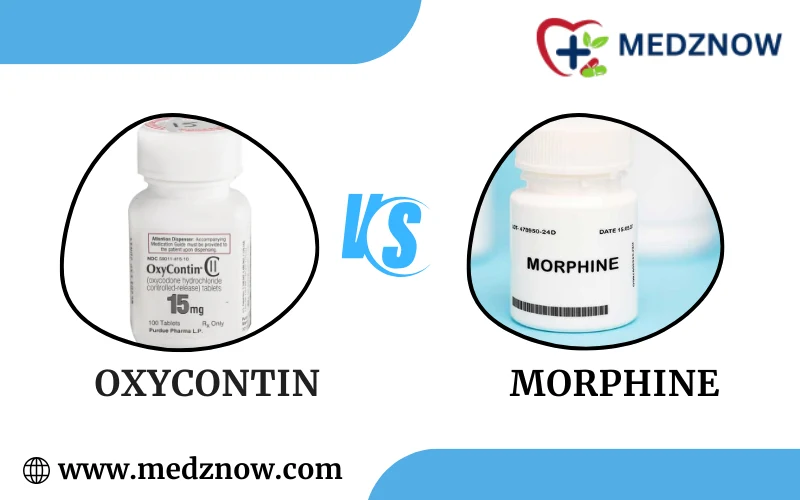
Pain management is an essential part of healthcare, especially when managing chronic and post-surgical pain. Among the most common prescription medications such as OxyContin and morphine. Both drugs are powerful pain relievers, but aren’t interchangeable. They have distinct differences in formulations, action duration, and potential side effects. In this article, we can explore the key differences between OxyContin vs morphine, or some queries such as is morphine and OxyContin the same thing, does OxyContin have morphine in it, and which is stronger, morphine or OxyContin, that can help to choose the most appropriate treatment option.
What Are OxyContin And Morphine?
OxyContin is the brand name of Oxycodone, that synthetic opioid drug. It’s designed to relieve pain for over 12 hours, and it treats moderate to severe pain that is most suitable for chronic pain like cancer, bursitis, neuralgia, arthritis, and severe back injury. The drug’s effect is similar to heroin use.
Morphine comes from the opium poppy, is a natural opioid drug. It’s available in various forms: oral tablet, injection, and extended release. The drug is commonly used to treat both short and long-term pain and relieve moderate to severe acute and chronic pain.
How Do They Work?
OxyContin is a synthetic opioid that works by binding to opioid receptors and responding to pain signals between the body and the brain. The drug lasts about twice as long and is taken every 12 hours for around-the-clock pain relief.
Morphine is a semi-synthetic opioid like Dilaudid and Heroin. It works by interacting with the opioid receptors in the central nervous system (CNS), which prevents the brain from receiving pain signals by attaching to these receptors. As a result, this leads to a relaxed, euphoric, and dreamlike state, enhancing the risk of opioid abuse and addiction.
What’s The Difference Between OxyContin And Morphine
Let’s discuss OxyContin and Morphine in terms of potency, administration, duration of action, and side effects that require individual pain management. This comparison might be helpful to better navigate the treatment of pain.
Effectiveness
Both drugs have different effectiveness, but some studies have found that OxyContin and morphine provide similar levels of pain relief for chronic pain, like cancer. OxyContin start its effects about 30 to 60 minutes and stays in the system 4 to 6 hours, while morphine starts its function about 30 to 60 minutes and lasts 4 to 6 hours. While their efficacy is comparable, OxyContin relieves pain faster than morphine.
Chemical Composition
Chemical composition is one of the best differences between OxyContin and morphine because their chemical composition are totally different. Morphine is a natural opioid that occurs naturally in opium poppy plants, while OxyContin is manufactured by synthesizing thebaine, which makes it a semi-synthetic opioid. Ingredients of OxyContin are
- lactose
- povidone
- Eudragit RS 30D
- glycerol triacetate
- stearyl alcohol
- talc
- magnesium stearate
Addictiveness
In the report, both Morphine and OxyContin are restricted as Schedule II controlled substances because they have a high potential for opioid abuse, dependence, and addiction. Thus, this drug is only obtained by prescription and requires careful consideration of its potential risks.
Administration
OxyContin is available in oral form; take it every 12 hours. The starting dose is OxyContin 10 mg, which may need to be adjusted or changed as directed by the healthcare provider. Morphine is available in Immediate-release and extended-release forms, and its administration
- For epidural dose: with a single dose of 0.2 to 1 mg that offers relief for up to 24 hours.
- For opioid-naive adults: the initial oral morphine dose is 15 mg to 30 mg every 4 hours as needed.
- For pediatric patients (50 kg weight): starting dose is 15 mg every 4 hours, with a maximum initial dose of 30 mg.
Similarities Of OxyContin And Morphine
Every opioid drug is a powerful pain-relieving medication, such as Oxycodone, Percocet, Vicodin, Norco, OxyContin, and Morphine. They have similar mechanisms and risk of side effects, addiction, dependence, overdose, or withdrawal. The following information is related to the similarities of OxyContin and Morphine.
Side Effect
OxyContin and Morphine have similar side effects, which commonly occur for drug intercation, overconsumption and frequent use. One has mild side effects, and the other has serious side effects. so be aware risks of these drugs before using.
Common Side Effects Of OxyContin And Morphine
- fatigue,
- nausea
- vomiting
- itchy skin
- confusion
- headache
- dry mouth
- drowsiness
- constipation
- lightheadedness
- increased sweating
- blood pressure
- heart rate issues
A certain patient can use OxyContin or Morphine for a longer time, which leads to some harmful side effects like tolerance/dependence, opioid use disorder (OUD), decreased fertility, sleep problems, constipation, liver, kidney, and other organ damage, overdose, coma, and death.
Drug Interactions
OxyContin or Morphine may need careful attention while taking them, and mostly careful about drug interactions. It is the most common reason for serious side effects. Both drugs interact with any other drugs. Thus, before using any other drugs, consult with your doctors.
- Antibiotics
- Other opioids (Oxycodone, Vicodin, Norco, Percocet)
- Antipsychotics
- Anticonvulsants (Lamictal, Gabapentin, Zonisamide)
- Muscle relaxers (Soma, Zanaflex, Lorzone)
- Benzodiazepines(Xanax, Ativan, Valium, Klonopin)
- Sleep medications (Ambien, Restoril, Lunesta)
- SSRIs, SNRIs, and other antidepressants
- Antifungal medications, such as ketoconazole
Can You Take OxyContin And Morphine Together?
In very rare cases, there are prescribed two medicine by the healthcare provider to control two conditions at the same time. Similarly, it is possible to take OxyContin and Morphine together under strict medical supervision. One for long-term pain (OxyContin) and another one for short-term pain (Morphine). If you are taking both drugs, then carefully manage your doses and monitor for interactions. Don’t try to self-medicate; combining opioids without professional guidance because both work similarly by binding receptors in the brain and reducing pain. Taking them together increases the risk of side effects such as
- respiratory depression,
- extreme sedation
- coma
- death
Which Is Stronger, OxyContin or Morphine?
OxyContin is stronger than Morphine in terms of its long-lasting functionality at case of lowest dose. It’s 1.5 to 2 times more productive than morphine in its oral forms. i.e Oxycodone 10 mg is approximately equivalent to 15 to 20 mg of Morphine. If questions arise, which one is better for you? The simple answer is that totally based on an individual’s metabolism and opioid tolerance. In this case, always consult with the healthcare provider. They determined which one is better for your specific condition.
Conclusion
OxyContin and Morphine are very sensitive tools for pain management. They have used it for different pains. Thus, if we choose the better option, it depends on the patient’s specific medical condition, pain management needs, and response to opioids. Both carry risks of dependence and side effects. So, always consult with the doctors to determine the safest and most effective treatment.