

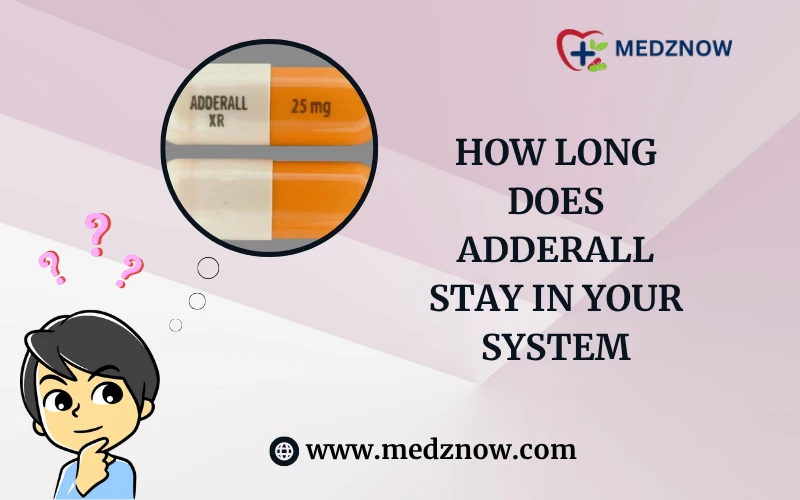
Adderall is widely prescribed to treat Attention Deficit Hyperactivity Disorder (ADHD) and narcolepsy. It improves focus, attention, and impulse control, but if you take Adderall. You might be wondering: How long does Adderall stay in your system? Usually, it stays in three days in the system, but in certain cases it’s influenced by many factors. Thus, various drug tests can detect Adderall within different time frames.
If you work in Employers, law enforcement, medical and mental health professionals, and sports organizations, these organizations commonly test the amphetamines test which are present in Adderall. The help of various tests determines whether a person has used Adderall or similar drugs. important to understand how does Adderall work in the body, how long it sticks around, how it’s metabolized, and what factors affect its duration.
What Is Adderall?
Adderall is a stimulant medication that mainly contains two ingredients such as amphetamine and dextroamphetamine. These substances increase the activity of certain neurotransmitters (dopamine and norepinephrine) in the brain, which helps to improve attention and decrease impulsiveness.
Its have two main formulations:
- Adderall IR (Immediate Release): It starts working within 30–60 minutes and lasts approximately 4–6 hours.
- Adderall XR (Extended Release): It is designed to last around 10–12 hours, releasing the medication in two phases.
How Long Does Adderall Stay In Your System?
High-profile and restricted organizations usually do drug tests, including urine tests, blood tests, hair tests, and saliva tests that determine whether the person has used Adderall or similar drugs. How long it stays in the system depends on dosage, frequency of use, and individual metabolism.
- Blood Test: The blood test detected up to 46 hours after the last dose. This test is a very common drug scanning method that detects recent usage.
- Urine Test: The urine test is a commonly type drug test that detects up to 2 to 4 days after last last dose.
- Saliva Test: detectable up to 20 to 50 hours. This test is easy but less accurate over a longer time frame.
- Hair Test: It detects up to 90 days after the last dose. The hair test is very rare and used for extended substance testing.
What Factors Affecting Adderall Detection Time?
Adderall is a common prescription drug that is used for short-term treatment of Attention Deficit Hyperactivity Disorder (ADHD) and Narcolepsy. The extended-release of Adderall (Adderall XR) is used for long-term treatment of ADHD. But how long the drug stays in the system depends on several factors, including dosage, frequency of use, individual metabolic rate, age, and health conditions.
Dosage And Frequency Of Use
It plays an important role in how long the drug stays in the system. High doses and more frequent use cause longer detection of drugs. Reminds information that Adderall is available form different formulations, immediate-release and extended-release formulations. Extended release formulations release the drug gradually over a longer period. Thus, Adderall XR stays in the system longer compared to the immediate-release versions.
Metabolic Rate
Metabolism is one type of chemical process that converts food and substances into energy within the body. Thus, each person has an individual metabolic rate that determines how quickly processes and eliminates Adderall. Faster metabolism clears the drugs rapidly from the system. While slow metabolizers take a longer time to eliminate the drugs.
Age And Health Condition
Age and health condition affect to duration of adderall in the system. Younger people have a faster metabolism that helps to eliminate the drug faster compared to older people. If the person has any health conditions, like liver or kidney disease, that can affect the body’s ability to process and eliminate drugs. Thus, it leads longer duration of Adderall in their system.
Risks And Side Effects Of Adderall
Adderall is highly effective for treating ADHD, but it also has various risks and side effects. If the person can misuse Adderall and take it without a prescription, or take in higher dose than prescribed, that increases the risk. The main dangers of Adderall include side effects, potential misuse, and the risk of addiction. Adderall affects to CNS, which can lead to side effects including,
- Headache
- Dry Mouth
- Appetite loss
- Digestive issues (Nausea, upset stomach, or constipation)
- Insomnia
- Heart complications (Increased blood pressure and a faster heart rate)
- Mood changes (Agitation, anxiety, or paranoia)
- Nervous system issues (restlessness and muscle twitches)
- Extreme fatigue or depression
How To Flush Adderall From Your System?
Recently, if you take Adderall and seek to eliminate the drug from the system quickly. Initially, know how your body processes the medication, which helps to reduce side effects and risks. No guarantee that the following way will eliminate Adderall from the system immediately. But after some time, your body automatically elimination the Adderall.
- Stay Hydrated: Drinking enough water supports kidney function and helps flush substances through urine.
- Maintain a Healthy Diet: Eat nutritious foods (rich in fiber, antioxidants, and vitamins).
- Exercise Regularly: Physical activity enhances metabolism, which helps your body process substances more efficiently.
- Avoid Acid-Reducing Medications: Adderall elimination can be slower, thus your urine is more alkaline. Avoid antacids or other medications that might increase urine pH unless prescribed.
- Get Rest: Sleep allows your body to repair and maintain and acts like a natural detox system.
Caution
- Avoid excessive sweating, sauna use, or detox products promising quick removal.
- Don’t stop medication without medical advice, as cause withdrawal symptoms and negatively impact your health.
- Avoid mixing with other substances like Alcohol or drugs (Xanax, Valium, Oxycodone, Percocet) that increase side effects.
Adderall Alternatives
Adderall is not the only option to manage ADHD symptoms. If you are looking for a natural and safe approach, have experienced side effects, or simply want to explore other medications, many alternatives to Adderall.
- There available several other prescription medications available that help to manage ADHd symptoms: Ritalin (Methylphenidate), Vyvanse (Lisdexamfetamine), Concerta (Methylphenidate Extended Release), and Strattera (Atomoxetine)
- Every medication carries various risks. If you can look natural, and lifestyle alternatives and options to treat ADHD. Several natural alternatives help improve focus and reduce ADHD symptoms. These are exercise, mindfulness meditation, diet and nutrition, and sleep hygiene
- Cognitive Behavioral Therapy (CBT) improves self-esteem, reduces impulsivity, and helps create effective routines and systems for staying on task.
- Some people seek natural supplements to support cognitive function and focus. These herbs are Ginkgo Biloba, Bacopa Monnieri, Omega-3 Fatty Acids, and L-Theanin
Final Thoughts
Adderall is eliminated from the body naturally over a few days. But various factors can increase the duration of Adderall in the system. If you are taking the Adderall as prescribed, then this drug screening is not an issue. Always consult a professional before making any changes to the dose or medication.